After David McCullough passed away, his daughter published a collection of his various speeches and writings into a book called History Matters. The picture on the cover is one of the most inspiring photographs of someone at work.
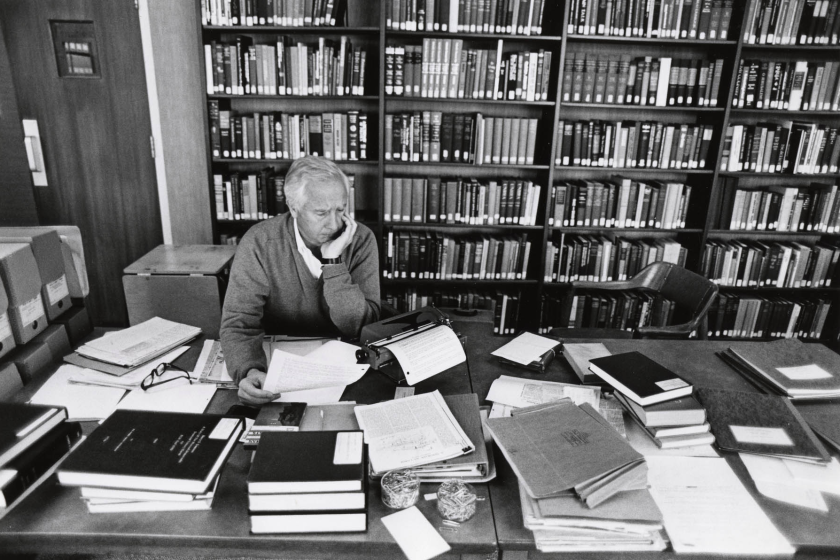
Because McCullough is my favorite author, I enjoyed this book thoroughly. Here are some notes and highlights.
On happiness and learning:
And how he loved that task. “We speak a language that isn’t ours,” McCullough notes in these pages. “It’s been handed down to us with a tradition of expression and power that is well worth a lifetime of study, and particularly for those for whom writing is a way of life. I love what I do. I love every day of it. Happiness—true happiness—is not to be found in vacations or the like. It’s to be found in the love of learning and doing what you really want to get up and get to each day.”
A good Churchill line:
Churchill in his great speech in the darkest hours of the Second World War, when he crossed the Atlantic, reminded us, “We haven’t journeyed this far because we are made of sugar candy.”
From Thomas Jefferson:
Any nation that expects to be ignorant and free,” Jefferson said, “expects what never was and never will be.
I resonate with this expression. Asking what happened—or how things happened—is a great way to go about life if you want to grow your knowledge and experience constant wonder.
I am not an engineer. I am not even a historian. I am an English major. But I am drawn to the past because I care to know what happened.
A man can dream:
Lucky finds and collections of great libraries and archival collections have happened for me again and again.
Some good advice:
Be generous. Give of yourselves. Count kindness as all-important in life. Take interest in those around you. Try to keep in mind that everyone you encounter along the way, no matter their background or station in life, knows something you don’t. Get in the habit of asking people about themselves, their lives, their interests, and listen to them. It’s amazing what you can learn by listening.
This following few quotes are from McCullough's interview with The Paris Review.
Interviewer: Would you tell us about the motto tacked over your desk?
McCullough: It says, “Look at your fish.” It’s the test that Louis Agassiz, the nineteenth-century Harvard naturalist, gave every new student. He would take an odorous old fish out of a jar, set it in a tin pan in front of the student and say, “Look at your fish.” Then Agassiz would leave. When he came back, he would ask the student what he’d seen. “Not very much,” they would most often say, and Agassiz would say it again: “Look at your fish.” This could go on for days. The student would be encouraged to draw the fish but could use no tools for the examination, just hands and eyes. Samuel Scudder, who later became a famous entomologist and expert on grasshoppers, left us the best account of the “ordeal with the fish.” After several days, he still could not see whatever it was Agassiz wanted him to see. But, he said, “I see how little I saw before.” Then Scudder had a brainstorm, and he announced it to Agassiz the next morning: “Paired organs, the same on both sides.” “Of course! Of course!” Agassiz said, very pleased. So Scudder naturally asked what he should do next, and Agassiz said, “Look at your fish.”
I love that story and have used it often when teaching classes on writing, because seeing is so important in this work. Insight comes, more often than not, from looking at what’s been on the table all along, in front of everybody, rather than from discovering something new. Seeing is as much the job of an historian as it is of a poet or a painter, it seems to me. That’s Dickens’ great admonition to all writers, “Make me see.”
(Emphasis added.) And later he says something similar about the process of writing his books in general:
The chances of finding a new piece are fairly remote—though I’ve never written a book where I didn’t find something new—but it’s more likely you see something that’s been around a long time that others haven’t seen. Sometimes it derives from your own nature, your own interests. More often, it’s just that nobody bothered to look closely enough.
On McCullough's strategy for writing, specifically about a young Theodore Roosevelt in Mornings on Horseback:
There’s another scene in Mornings on Horseback that I felt was crucial to understanding Roosevelt’s character, which might not be considered important by conventional standards. The family was taking a trip up the Nile, and young Theodore, who was an amateur taxidermist, shot and stuffed a number of birds. So I went out and found out how taxidermy is done. It takes patience and dexterity, and it’s smelly and grubby—a kind of work that would be very difficult for a child. And if you do it on a boat with your whole family present, you upstage them all. There’s a paragraph or two in the book about the process of stuffing a bird, because I thought that would show a lot about the boy. I didn’t want to say, “He was a bright boy who did things other boys couldn’t.” I wanted the reader to know it.
(Emphasis added.) Another time McCullough did this was in Truman. Harry Truman wanted badly to fight in World War One, but he had horrible eyesight. He knew that he wouldn't be chosen if he showed up to the initial exams with his glasses. So, he memorized the lines in the eye chart, and was able to read off the letters when they were called. That's grit. That's motivation. That's letting nothing stop you. But rather than saying "Truman had grit," telling the story of how Truman bypassed the eye test reveals that grit in a much more dramatic way.
Advice on what to write a book about:
Thornton Wilder was a fellow at my college at Yale. Here was a world-celebrated writer for us to talk to, to have lunch with—imagine!—and he was easy to talk to, delightful. Later, while working in New York, I read the interview with him in The Paris Review. I can’t tell you what a difference it made for me. When asked why he wrote books and plays, he said, “I think I write in order to discover on my shelf a new book which I would enjoy reading or to see a new play that would engross me.” If it didn’t exist, he wrote it so he could read it or see.
How to write consistently:
One evening, in New York, at a gathering of writers and historians interested in the West, my boss, Alvin Josephy, pointed to a white-haired man across the room. He said, “That’s Harry Drago. Harry Sinclair Drago. He’s written over a hundred books.” I waited for my chance and walked over. “Mr. Drago,” I said, “Alvin Josephy says that you’ve written over a hundred books.” “Yes,” he said, “that’s right.” “How do you do that?” I asked. And he said, “Four pages a day.” “Every day?” “Every day.” It was the best advice an aspiring writer could be given.
And on a similar note:
Sometimes I think I’m not a writer, I’m a rewriter. When a page isn’t working, I crumple it into a ball and throw it in the wastebasket. Always have. Our son Geoffrey when he was a little boy would come out where I work and look in my wastebasket to see how many “wrong pages” I had written that day. If the basket was full, it had been a good day. I’d worked things through.
McCullough uses a unique aspect of narrative storytelling in his biographies. The pattern is common now, but it wasn't when McCullough began writing. But this was always his intention, inspired mostly by Sir Walter Lord's excellent narrative of the sinking of the Titanic in A Night to Remember:
I never had any intention of writing except in the narrative form. I believe in the strong narrative. In E. M. Forster’s Aspects of the Novel, he talks about the difference between a sequence of events and a story. He says, If I tell you that the king died and then the queen died, that’s a sequence of events. If I tell you that the king died and then the queen died of grief, that's a story—you feel that.
As a typewriter enthusiast, I can't help but relish this passage:
I write on an old Royal typewriter, a beauty! I bought it secondhand in 1965, before I started The Johnstown Flood, and I’ve written all my books on it. It was made about 1941, and it works perfectly. I have it cleaned and oiled about once every book, and the roller has to be replaced now and then. Otherwise it’s the same machine. Imagine—it’s more than fifty years old, and it still does just what it was built to do! There’s not a thing wrong with it.
I love putting paper in. I love the way the keys come up and actually print the letters. I love it when I swing that carriage and the bell rings like an old trolley car. I love the feeling of making something with my hands. People say, “But with a computer you could go so much faster.” But I don’t want to go faster. If anything, I should go slower. I don’t think all that fast. They say, “But you could change things so readily.” I can change things very readily as it is. I take a pen and draw a circle around what I want to move up or down or wherever, and then I retype it. Then they say, “But you wouldn’t have to retype it.” But when I’m retyping I’m also rewriting. And I’m listening, hearing what I’ve written. Writing should be done for the ear. Rosalee reads aloud wonderfully, and it’s a tremendous help to me to hear her speak what I’ve written. Or sometimes I read it to her. It’s so important. You hear things that are wrong, that call for editing.
Listen to your editors—especially when they are your spouse.
Yes, I make a little mark, or she does. Once when she [Rosalee McCullough] was reading one of the last chapters of Mornings on Horseback, she stopped and said, “There’s something wrong with that sentence.” I said, “Read it again.” She read it again, “There’s something wrong there.” I said, “Give it to me, you’re not reading it right,” and I read it out loud and said, “See?” Well, a year or so later, when the book was published, Gore Vidal reviewed it in The New York Review of Books. It was a favorable review, and I was very pleased, except that, out of the whole book, he singled out one sentence as an example that my writing wasn’t always the best. And it was that sentence! The only one he quoted!
I think I'll use this line when someone asks what my favorite book is—the one I'm reading now, of course.
I’m often asked which is my favorite book, and it’s always the same: the one I’m working on. And I feel that now. I really look forward to going out there tomorrow morning and working on chapter three. The time will fly.
There is not a correlation between the time spent studying during the day and the amount of knowledge that is increased:
“Strain your brain more than your eye,” Eakins would tell his own students at the Pennsylvania Academy of the Fine Arts, where he had established the most rigorous curriculum of any art school in the nation. “A few hours’ intelligent study is better than a whole day of thoughtless plodding.”
On the most important characteristic in a President:
Character Above All is the title of this book, and character counts in the presidency more than any other single quality. It is more important than how much the president knows of foreign policy or economics, or even about politics. When the chips are down—and the chips are nearly always down in the presidency—how do you decide? Which way do you go? What kind of courage is called upon? Talking of his hero Andrew Jackson, Truman once said, it takes one kind of courage to face a duelist, but it’s nothing like the courage it takes to tell a friend no.
I liked this line on courage: "Courage is having done it before."
This importance of history is not just for Presidents—it's for everyone. While knowing how the world came to be is important, if you are an American and want to responsibly exercise your civic duty, you must—absolutely must—know (or be actively pursuing knowledge about) what has been tried, what has worked, and what has not. You have to know why elections were lost or won, or the pivotal issues that were at the top of mind for Americans in different decades. I believe that without some overall understanding of those things, it is very hard to know how to vote or live.
TRUMAN’S PROFOUND SENSE OF history was an important part of his makeup. He believed every president should know American history at the least, and world history, ideally. A president with a sense of history is less prone to hubris. He knows he is but one link in a long chain going all the way back to the first president and that presumably will extend far into the future. He knows he has only a limited time in office and that history will be the final judge of his performance. What he does must stand the test of time. If he is blasted by the press, if his polls are plummeting as Truman’s did during the Korean War, these are not the first concerns. What matters—or ought to matter—is what’s best for the country and the world in the long run.
John Adams shared a similar sentiment:
Liberty cannot be preserved without general knowledge among the people who have the right to that knowledge and the desire to know. But besides this, they have a right, an indisputable, unalienable, indefeasible, divine right to that most dreaded and envied kind of knowledge—I mean of the character and conduct of their rulers.
One of the underlying themes in Truman is President Truman's humility.
In the course of more than one hundred interviews for my biography of Truman, I found no one who had worked with him, no one who was on the White House staff, or the White House domestic staff, or his Secret Service detail, who did not like him. He knew everybody by name on the White House staff and in the mansion itself. He knew all the Secret Service people by name. He knew all about their families—and this wasn’t just a politician’s trick. If he could have picked his own father, one former Secret Service man told me, it would have been Truman.
And principles:
When friends and advisers warned [Truman] that he was certain to lose the election in 1948 if he persisted with his civil rights program, he said if he lost for that, it would be for a good cause. Principle mattered more than his own political hide. His courage was the courage of his convictions.
A paraphrase of a quote from a biographer about Dr. Ezra Stiles: "He kept sacred his omnivorous curiosity. He was always more interested in what he did not know than in what he did."
A book at the foot of the bed for Christmas—what a wonderful gift.
Christmas and books have been tied up together in my mind for so long I’m not altogether sure whether it’s because of my feelings for Christmas that I love books, or if it’s the other way around. In any event, as my family knows, books are what I give at Christmas, and books are what I hope to be receiving come the magic morning; and as all in my family—children, grandchildren—also know, this goes back to a Christmas tradition started by my mother and father in the home where I grew up in Pittsburgh.
Every Christmas Eve, we McCullough children—four boys—went to bed knowing what to expect the next morning. Well before our father had put on his ancient, faded Indian blanket bathrobe to lead the march downstairs to who knew what Christmas bounty in the living room, even at the very moment of opening our eyes, we would each find a first present at the foot of our bed.
It was always beautifully wrapped, with ribbon and bow, and it was always a book. And thus did the biggest day of the year begin at 549 Glen Arden Drive.
Now, with this glorious moment went an implicit understanding that once having opened our books, we four, each on his own, would spend time enjoying it to himself—quietly, that is—and thereby grant mother and father more sleep. And in time to come, having become a parent, I would see in this, as in other things, the wisdom of my mother and father. So my five children, too, were to awaken Christmas mornings to find books at the foot of their beds, and my wife and I, too, having been up most of the night wrapping presents, struggling to assemble this or that impossible-to-assemble game or toy, would enjoy a blessed extra half hour or so of morning sleep.
Churchill once wrote that the most industrious, useful people of society may be divided into two categories—those who work with great intensity at their job and for pleasure, for relief, turn to golf or travel or vacation. And then there are those for whom their work and their real joy in life are one and the same—who are thus on vacation every day. And they are the luckiest of all.